


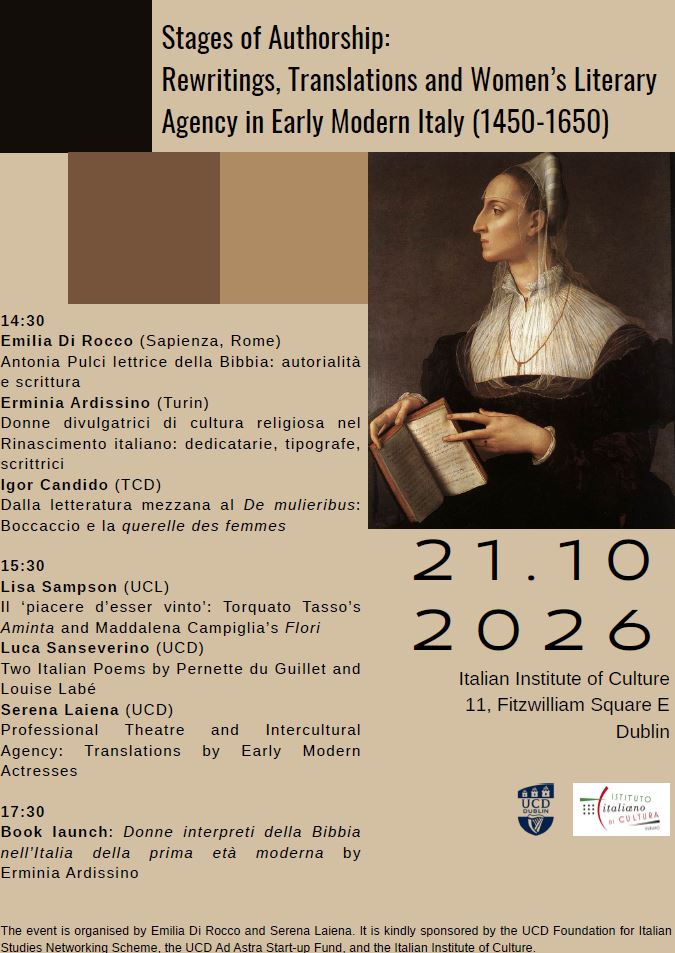
The Italian Institute of Culture in Dublin is delighted to present the workshop “Stages of Authorship: Rewritings, Translations and Women’s Literary Agency in Early Modern Italy (1450–1650)”.
The event is organised by Emilia Di Rocco and Serena Laiena, and it is kindly sponsored by the UCD Foundation for Italian Studies Networking Scheme, the UCD Ad Astra Start-up Fund, and the Italian Institute of Culture in Dublin.
This workshop focuses on women’s engagement with the rewriting and circulation of texts between 1450 and 1650, and aims to map the strategies through which women negotiated literary and intellectual agency. In this period, the rise of print culture and the shifting boundaries of intellectual social authority shaped a new landscape of textual production and dissemination. Within this changing landscape, women played vital roles as authors, translators, patrons, readers, and performers, shaping early modern intellectual and artistic life in complex ways.
Figures such as Antonia Pulci in fifteenth-century Florence exemplify how women engaged with devotional drama and moral narrative to assert spiritual and moral authority within socially sanctioned frameworks. Pulci’s sacre rappresentazioni not only adapted religious stories for performance but also subtly redefined female piety and agency within public devotional spaces.
At the same time, the emergence of professional female performers in Italy, France, and Spain expanded women’s influence in the theatrical sphere. Actresses not only embodied and circulated dramatic texts through performance but also participated in their adaptation and transmission, contributing to the evolving relationship between written and performed culture.
Practices of rewriting and translation offered women avenues for authorship that were socially acceptable yet intellectually ambitious, enabling them to shape and reinterpret canonical works. At the same time, the expanding networks of print and manuscript circulation enabled women’s voices to reach wider audiences, despite persistent censorship and gendered marginalisation. This workshop reflects on how this period marked a formative stage in the emergence of women’s textual authority.
The event is SOLD OUT.